Quick Summary
Arizona’s desert climate, high household water demand, and mineral-heavy supply make the decision between tankless and traditional water heaters more complex than in many other regions. Tankless systems deliver continuous hot water, save space, and reduce standby energy loss, but they come with higher upfront installation costs and require regular descaling due to hard water conditions. Traditional tank units may still fit smaller households or lower usage patterns, while larger families or high-demand homes often benefit from tankless efficiency. The best choice depends on household size, usage behavior, and commitment to ongoing maintenance.
Choosing a tankless water heater in Arizona is not the same decision as it would be in a milder, softer-water climate. Desert homes deal with a unique combination of high water usage, extreme summer heat, and mineral-heavy water that all affect how a water heater performs over time.
Before deciding between tankless and traditional tank systems, it helps to understand how these local conditions change the equation.
How Desert Conditions Affect Water Heaters
Arizona’s desert climate creates operating conditions that directly impact water heater performance, efficiency, and overall lifespan. High household demand, mineral-heavy water, and extreme seasonal temperatures all play a role. This makes it important to evaluate local conditions alongside energy efficiency and installation cost when choosing a system.
Understanding these factors helps homeowners select a water heater that delivers consistent, long-term reliability based on real usage conditions rather than general assumptions.
High Water Usage Patterns
Arizona homes, particularly those with pools, larger households, or frequent guests during snowbird season, tend to use more hot water than the national average.
This constant demand puts extra strain on any water heating system, and it is one of the biggest factors homeowners should weigh when comparing tankless vs. tank water heater options.
Hard Water and Sediment Buildup
Much of Mohave County is affected by hard water conditions, meaning elevated mineral content that gradually accumulates inside plumbing systems.
In traditional tank water heaters, these minerals settle at the bottom of the tank and form sediment buildup. This sediment reduces heating efficiency and increases strain on internal components, which ultimately shortens the system’s lifespan.
Tankless systems are affected differently, since water flows continuously through the unit rather than being stored. However, mineral scaling can still build up inside heat exchangers and impact performance if not maintained properly.
Pros of Tankless Water Heaters in Arizona
- Continuous hot water: Tankless units heat water on demand, meaning you will not run out during back-to-back showers or when running appliances simultaneously.
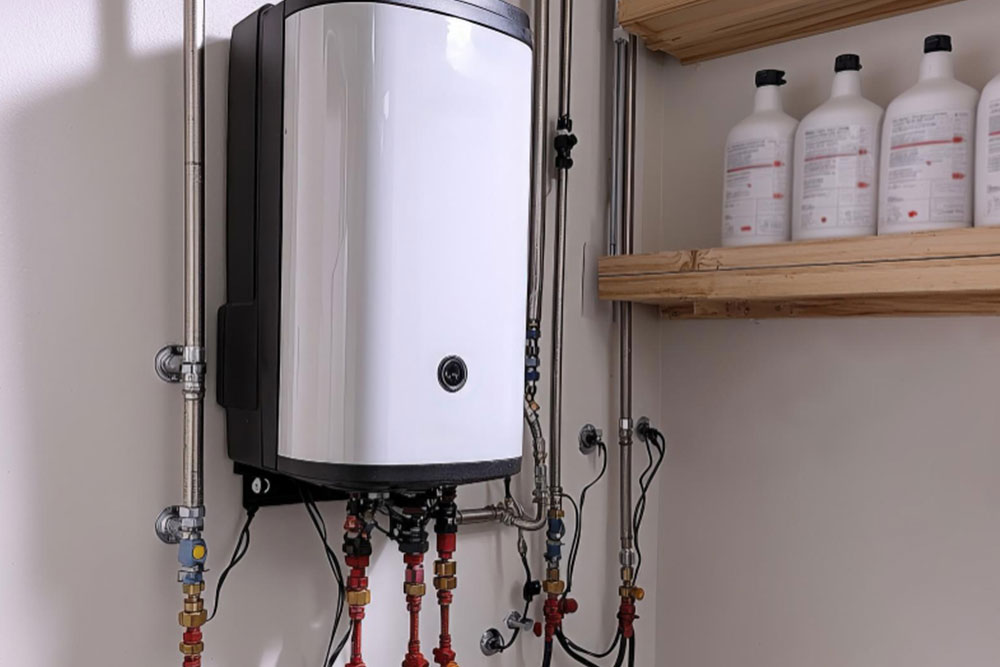
- Space savings: Tankless units mount on a wall and take up a fraction of the space a traditional tank requires, which is useful in smaller Arizona homes or garages already tight on room.
- Longer lifespan when maintained: With proper maintenance, tankless systems often last longer than traditional tanks, which matters given how hard water accelerates wear on any water heating system.
- Lower standby energy loss: Because tankless units only heat water when it is needed, they avoid the standby energy loss that traditional tanks experience from keeping a full tank hot around the clock.
Cons of Tankless Water Heaters in Arizona
- Higher upfront cost: The water heater cost in Arizona for a tankless unit and installation is typically higher than a comparable tank system, though many homeowners recover some of that cost through energy savings over time.
- Requires regular descaling: Because of the area’s hard water, tankless units need periodic descaling to prevent mineral buildup from affecting performance. Skipping this maintenance can shorten the unit’s effective lifespan considerably.
- Not always a simple swap: Depending on your home’s existing setup, switching from a tank to a tankless system may require adjustments to gas lines, venting, or electrical capacity, which adds to installation complexity and cost.
Tankless vs. Tank: Which Makes Sense for Your Home
For smaller households with moderate hot water needs, a traditional tank may still be the more cost-effective choice upfront.
For larger families, homes with multiple bathrooms, or properties that see heavy seasonal use such as vacation rentals, an on-demand water heater in Bullhead City or similar communities often pays off through consistent hot water and long-term efficiency.
The right choice also depends on your home’s existing plumbing. A water heater installation assessment can determine whether your home is a straightforward fit for tankless or whether modifications would add significant cost.
Protecting Your Investment with Water Treatment
Since hard water is one of the biggest threats to any water heater’s lifespan in this region, pairing your system with a water treatment solution can significantly reduce sediment buildup and extend the life of either a tank or tankless unit.
This is one of the few upgrades that benefits nearly every plumbing fixture in your home, not just your water heater.
Commercial Considerations
Businesses with high hot water demand, such as restaurants or laundry facilities, face similar decisions but at a larger scale. If you manage a commercial property, it is worth speaking with a commercial plumbing specialist about whether a tankless system or a high-capacity tank setup better fits your operation’s demand patterns.
Making the Right Choice for Your Fort Mohave Home
There is no universal answer here. The right water heater depends on your household size, usage patterns, budget, and how much you are willing to invest in ongoing maintenance.
We help homeowners throughout Fort Mohave weigh these factors honestly, without pushing a one-size-fits-all recommendation.
Ready to Explore Your Water Heater Options?
Whether you are leaning toward tankless or want to compare it against a traditional tank, contact us for an honest assessment based on your home and your household’s needs.
FAQs
Are tankless water heaters worth it in Arizona's hot climate?
For many households, yes, especially those with high hot water demand or limited space. The upfront cost is higher, but the long-term efficiency often balances that out.
How does hard water affect tankless water heaters?
Hard water causes mineral scale to build up inside the unit’s heat exchanger, which reduces efficiency over time. Regular descaling helps prevent this issue.
What is the average lifespan of a tankless water heater in Arizona?
With proper maintenance, tankless units can last 15 to 20 years, though hard water conditions make consistent descaling essential to reach that range.
Is switching from a tank to a tankless expensive?
It depends on your home’s existing gas line, venting, and electrical setup. Some homes require minimal changes, while others need more significant upgrades.
Do tankless water heaters work well for larger families?
Yes, as long as the unit is properly sized for simultaneous demand. An undersized unit can struggle when multiple showers or appliances run at once.
Comments are closed